
Windows
The Stained Glass Windows of Saint James’ Warrenton
Saint James’ Episcopal Church in Warrenton, Virginia, has an extraordinary collection of stained glass windows. Technically they range from the painted style characteristic of the Victorian period to the opalescent process introduced in the late nineteenth century American Renaissance movement to a twentieth century version of medieval pot metal glass. Stylistically the windows reflect the changes that have occurred over the century of their production, yet they blend harmoniously with the Gothic setting of the church fabric.
In 1910 Saint James’ burned. Among the items saved and incorporated into the new structure were the two stained glass windows on the east side of the south aisle. When the new church opened for services in 1912 at least two more windows were in place and a fifth probably followed soon after. From the 1920s to the late 1950s four more windows were added and in the 1960s eight windows were installed, five of them in the chapel.
With a few exceptions all of the windows are the product of J. and R. Lamb Studios. Founded in 1857, the Lamb Studios have been associated with ecclesiastical stained glass for 150 years. The medieval guild tradition characteristic of the Lamb Studios resulted in few windows being signed, but work records and comparison with other works of art reveal the identity of several designers. Frederick Stymetz Lamb, son of one of the founders, Ella Condie Lamb, and her daughter, Katharine Lamb Tait, were major designers for the studio from 1885 to 1979. Saint James’ is fortunate to have windows probably designed by all of these artists as well as signed examples by Margreta Overbeck, who came to Lamb Studios in 1939.
Information on the windows was researched and compiled by Dr. Aileen Laing in 1995 and revised 2023. Photographs were taken by Coy Ferrell and Nancy Kincheloe assisted with typing and editing.
CHURCH: SOUTH AISLE (WEST TO EAST)St. Anne and the Blessed Virgin Mary
Given in memory of Clare Eileen Jones (1902-1959) by her husband, Norman.
Both Eileen and Norman were members of Saint James’; Norman Jones was with the British embassy and then the World Bank. The young Virgin kneels and raises her hands in prayer toward an open book. St. Anne stands behind her holding a scroll and gesturing toward the descending dove above the inscription “Blessed are the pure in heart.” At the top, two angels hold a crowned shield with the Virgin’s monogram above the word “Ave” (Blessed). Pot metal glass designed by R. Geissler Inc. of Little Neck, New York.
St. John the Divine
Given in memory of Stuart Archer Smith (1913-1957).
Stuart was married to Margaret Noland and was the founder of the Fauquier Laundry. The angels dispensing their vials and their inscription, “And I saw a new Heaven and a new Earth”, indicate that the subject is drawn from the Revelation to John (The Apocalypse). Pot metal glass designed in a semi-cubist style by Margreta Overbeck for Lamb Studios in 1958.
Archangel Michael
Given in memory of Capt. Allen Townsend Winmill (1915-1944) by his parents, Robert and Viola Winmill.
Capt. Winmill, who served in the U.S. Army Air Force, was killed in action during the China-Burma-India action of World War II. The Archangel Michael, who defeated Satan in the Battle for Heaven (Rev. 12:7-9) is an appropriate subject for such a warrior. Pot Metal glass by J. and R. Lamb Studios in 1946 and possibly designed by Katharine Lamb Tait.
Peace
Given by John Wise Esq. in memory of his daughter Agnes Wise who died March 25, 1902, at 18 years old.
Peace was the first window at Saint James’ produced by the Lamb Studios. Known as “The Lady with the Dirty Neck” to generations of children, this window was salvaged from the old church, but bears the mark of its vicissitudes in the fire. Peace, represented as a young woman possibly in emulation of the deceased, stands quietly and gently cradles a dove. Her gaze seems contemplative and directed inward. The landscape is bucolic, the colours soft. Opalescent glass designed by Lamb Studios in 1903. The designer was possibly Ella Condie Lamb.
Christ’s Appearance to Mary Magdalene
Given in memory of Inman Horner Payne (1821-1905).
This window was also saved from the old church. The subject is drawn from John 20:11-17. Mary Magdalene kneels in front of a rocky promontory suggestive of the tomb and reaches out to touch the man she thought was the gardener but now recognizes as Christ (note the spade lying in the foreground; the crown of thorns is also evident). He lifts his arm to prevent her touch and speaks, “Do not hold me for I have not yet ascended to the Father.” Rich narrative detail such as this is typical of nineteenth century painted glass. Stylistically the lush setting of the garden and rocky cave is reminiscent of the work of Leonardo da Vinci as is the mystical nature of the blue background. Designer unknown.
Archangel Gabriel
Given in memory of Minerva Winston Payne (1861-1897) by her husband, Eppa Hunton Jr.
Erva had a beautiful voice and was both a harpist and pianist. The location of the window in the choir and the inclusion of a harp complete with metal strings are especially appropriate for this gifted woman. By tradition Gabriel stands at Heaven’s door to welcome the blessed. Opalescent glass commissioned for the new church. The designer was probably Ella Condie Lamb, as it replicates the painting for which she won the coveted Dodge Prize in 1889.
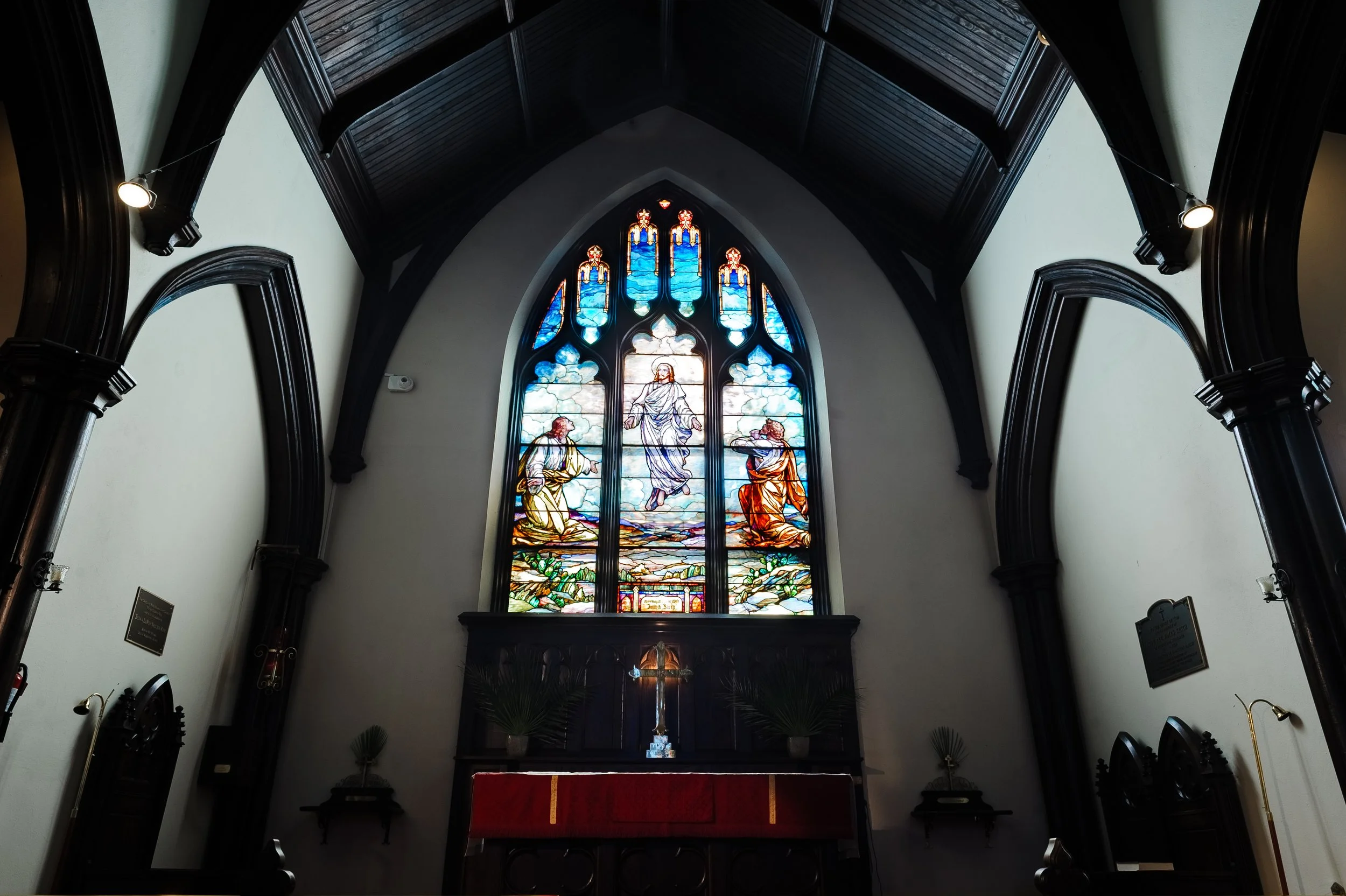
Ascension
Given in memory of Julia Kean Barry (1843-1910) by her husband, Maj. Robert P. Barry.
The Barrys’ daughter married a descendant of the Rev. James Keith, the first priest in the parish, and their descendents are still active members of Saint James’. Designed in the Lamb Studios in 1911, the great east window presents an abbreviated version of the Ascension. Only two apostles witness the event; although they are not labeled, it is tempting to identify them with John, the beloved disciple, and James, his brother and titular saint of this church. Stylistically reminiscent of Raphael’s Transfiguration, the window resonates with the force of Christ’s Glory. Technically, it reflects the skill of Lamb Studios in the use of plating as well as opalescent and jeweled glass. It is probably the design of Frederick Stymetz Lamb.
CHURCH: SOUTH AISLE (WEST TO EAST)Christ Preaching
Given in memory of James Landale (1830-1906) and Mary Haigh Landale (1835-1912) by their sons.
The Vestry minutes of 1913 record the acceptance of the window but no other details. Christ stands against a backdrop of rock-bound water and distant hills. He stands in the pose of a classical orator with his left arm raised. The subject is unclear and may be multifarious, but whatever scriptural interpretation one gives it, Christ definitely engages the viewer and offers his message of salvation to us today. Opalescent glass.
St. Elizabeth
Given in memory of Elizabeth Gaines Jones by her husband, Meriwether Jones, according to the Vestry minutes of 1928.
St. Elizabeth, mother of John the Baptist, stands before a massive stone building with a round arch of the type used to symbolize the Old Dispensation. Is she awaiting the arrival of her cousin Mary as she faces the altar and the Christ of the Ascension, the New Dispensation? Opalescent glass.
St. James
Given in memory of Arthur Mowbray Randolph Charrington (1887-1964).
The titular saint of the church turns toward the north west entrance to welcome worshippers into his church. Both his halo and the shield in the lower right contain shells, James’ identifying symbol. According to medieval tradition James’ body was miraculously transported across the sea to the northwest coast of Spain where a shrine was constructed at Compostella. All visitors to the site were given a shell. Designed in 1965 by Lamb Studios.
Adoration of the Magi
Given in memory of Anne Camden Spilman (1862-1958) by her children and grandchildren.
The words on the great west window, “Power, Majesty, Wisdom, Mercy, Justice” are appropriate as a memorial to the matriarch of a large and devoted family who, under her tutelage, have remained faithful members of Saint James’. They also encapsulate the meaning of this Epiphany window. The power of Joseph’s earthly lantern is weak compared to the star which bathes the entire scene in light; the wise and powerful kings kneel in submission to the greater power, majesty, and wisdom of the Christ child; the maternal love expressed in the way the young mother cradles her baby is mild compared to the love Christ bears for the faithful as a result of which we all trust in his justice and hope for his mercy. Like the glorious Ascension of the east window, this Epiphany window was produced in the Lamb Studios but reflects the more abstract style of the later 20th century. It was designed and painted by Katharine Lamb Tait, the leading designer of the firm from the 1920s until her retirement in the 1980s.
Our Father
Given in memory of William Lansing Rochester III (1951-1964), son of William L. Rochester II and Elizabeth “Babs” Batchelder Rochester.
Christ as a youth kneels in prayer surrounded by various woodland animals and birds. Pot metal design by Lamb Studios in 1969. Probably designed by Katharine Lamb Tait.
CHAPEL: EAST END (NORTH TO SOUTH)Follow Me
Given in memory of Richard Rice Barrett (1878-1938) by his children. Now the motto of Saint James’ Episcopal School.
The subject is particularly appropriate for a man, who, according to his family, loved to go fishing. Peter and Andrew with nets full of fish leave their boats and approach Christ who has just called them to “follow me” (Matt. 4:18-20). Christ’s power of persuasion is suggested by the disciples’ upturned faces and modified genuflection as well as his looming figure leaning inward with right arm raised to call them upward. Pot metal designed by Lamb Studios in 1966.
Father, Not My Will, But Thine, Be Done
Given in memory of Anne Camden Barrett (1888-1963) by her children.
This window functions as a pair with “Follow Me” reinforcing the links between the husband and wife in whose memory they were donated. Both figures are clothed in red and both face the altar, but one illustrates Christ’s ministry, the other his passion. Christ kneels in the garden of Gethsemane (Matt. 26:36-39). Facets of multi-hued glass suggest heavenly rays, which bathe His upturned face. His human weakness is suggested by his subordinate position, but his willingness to be subject to God’s will even unto death is also implied. Pot metal glass designed by Lamb Studios in 1966.
CHAPEL: EAST END (NORTH TO SOUTH)Jesus Christ and John the Baptist as Children
Given in memory of Karen Juanita Fout (1954-1957).
Christ in red (note the subtle indication of his cruciform halo) reaches out toward the fish in the sea. The theological significance, which associates fish with Christ’s followers, is clear, but his childish enthusiasm and John’s eager glance captures the innocence of childhood, appropriate for a window in memory of a child. Designed by Margreta Overbeck for Lamb Studios in 1968.
Suffer the Little Children to Come Unto Me
Given in memory of Alexander Dixon Daniell (born 1904) and Ann Alexander Daniell (born 1897) by their mother, Elizabeth Reeves Payne Daniell.
Christ declared that “whoever does not receive the kingdom of God like a child shall not enter it” (Luke 18:17). He strolls through an idyllic (heavenly?) landscape holding a small boy in his arms. A young girl at his side offers him a bouquet of flowers. Not only do the children represent the Daniell children, but also they symbolize all Christians who follow Christ. Designed by Margreta Overbeck for Lamb Studios in 1967.
I Am the Good Shepherd
Given in memory of the Rev. Paul Delafield Bowden (1894-1968).
The rector of Saint James’ from 1920 to 1963 was also active in civic affairs in Warrenton, acting as a shepherd to more than just his own flock. Christ stands in a landscape, the hot colours of which suggest evening. He holds a shepherd’s crook in one hand and cradles a lamb in his other. Other sheep cluster at his feet seeking reassurance. The window is composed of facets of coloured glass, which dissolve into a semi-cubist abstraction yet preserve the image; the window is both traditional and modern. Pot metal glass designed by Lamb Studios in 1968.