Compiled by the History Committee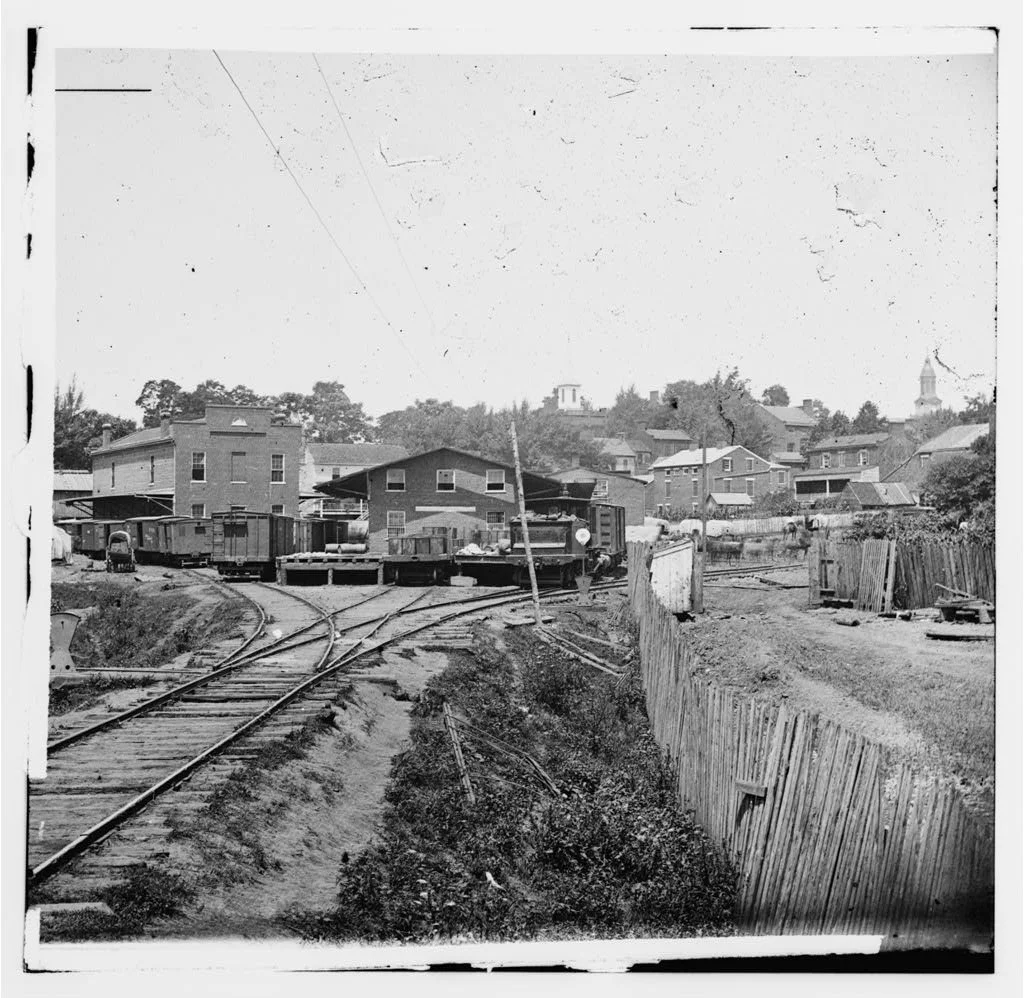
The Warrenton rail depot in 1862. The Saint James’ steeple can be seen in the background. (Timothy H. O’Sullivan via the Library of Congress)
In January 1859, the Rev. Otto S. Barten became rector of Saint James’. He served throughout the Civil War. Although Vestry minutes do not exist for the Civil War period — perhaps it being wiser not to have a written record of church leadership activities — sources reveal that during the long, dark years of the war, Barten carried out his ministry under the most trying circumstances. It was said to be unlikely that any man could have been found in all the land who would have risen more perfectly to the stern duties of that time. To quote, “he was sympathetic, indomitable in energy, inexhaustible in resource, he went in and out among a people stricken with poverty, torn by alarms and broken-hearted with bereavements to help, to strengthen and console.”
Early in the war, on June 1, 1861, Capt. John Quincy Marr of the Warrenton Rifles was killed at Fairfax Court House, becoming the first Confederate soldier to die in the war. He had been the commonwealth’s attorney and sheriff and lived at 118 Culpeper St. near Saint James’. When news of his death reached Warrenton, the Confederate flag was lowered to half-staff. His remains reached town Saturday evening, being met and entered into town by the Lee Guard and a great number of saddened citizens. Barten presided over a service in Marr’s memory attended by 1,500 people in the Clerk’s Office yard. Marr was then buried in full dress uniform and all the honors of war in the town cemetery at 5 p.m. Sunday afternoon.
As war intensified, Barten served under increasing pressure. The commander of the Union forces occupying Warrenton informed Barten that if he didn’t pray for the North at his services, the church would be destroyed. Barten henceforth prayed that the “right” side would be victorious, and the church was saved!
In the year 2000, Isabelle Hilleary wrote this vignette about her father, a faithful member of Saint James’: “When Mr. Richard Hilleary was a small boy at the time of the Civil War, Union soldiers were riding on horseback on the Springs Road. They stopped and asked him: ‘What are you little boy?’ He replied, ‘I’m an Episcopalian!’”
(Richard Hilleary was senior warden and Vestry member for some 50 years. He remained on the Vestry until vestries were elected by the congregation. He also served on the Warrenton Town Council and owned a dry goods and grocery story on Main Street.)
We know that all the churches in Warrenton, with the exception of Saint James’, were used by the Union army as hospitals. The Presbyterian church was also used as a stable; horses were kept in the basement and fed through holes cut in the floor above. Saint James’ may have been left unharmed because of its Gothic architecture, which made it less suitable for a hospital. (The church building that existed during the Civil War burned down in 1910.) As a result, it served as a place of worship by all denominations, as well as by Union soldiers.
This essay was originally published in 2016 to mark the bicentennial of Saint James’ Warrenton.